
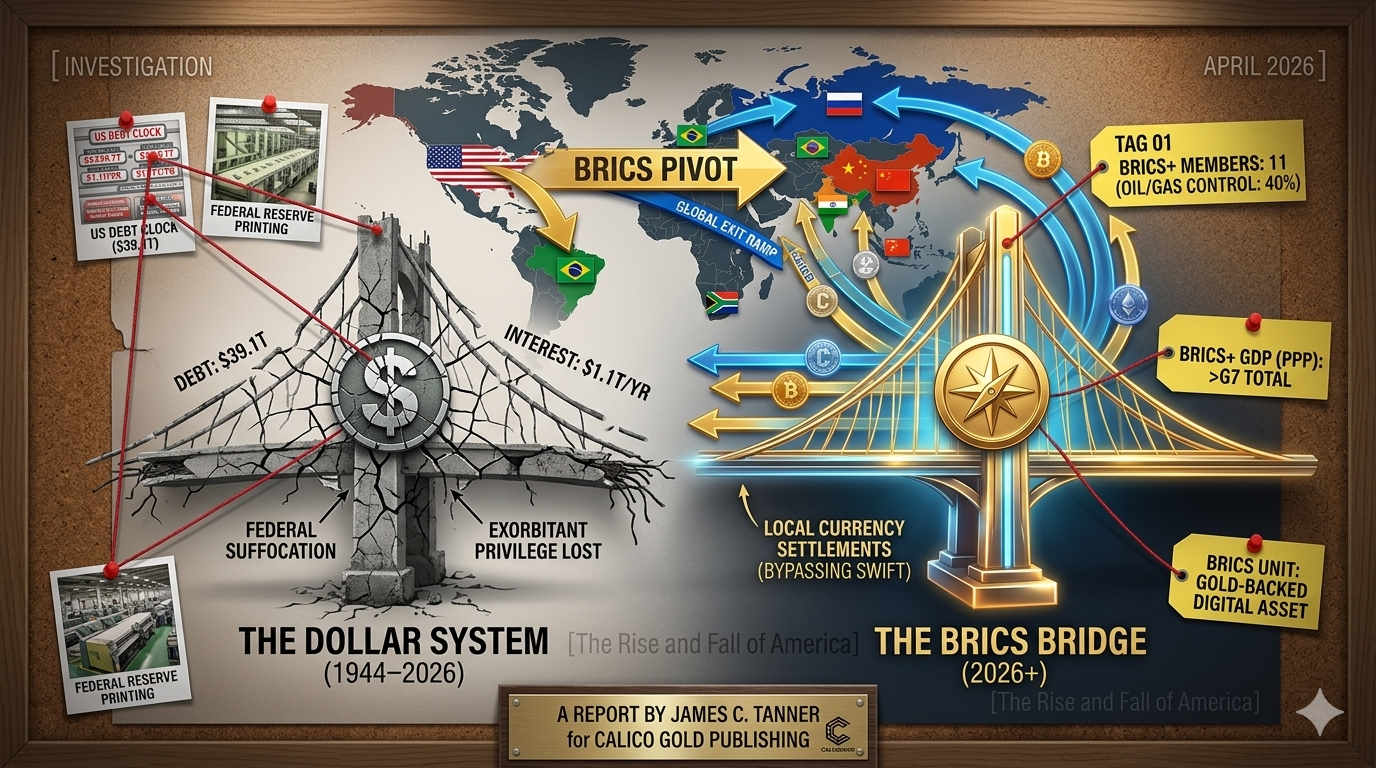
The forensic evidence of 2026 is clear: the world is no longer waiting for the United States to fix its $39.1 trillion debt crisis. Instead, we are witnessing the BRICS pivot—a massive geopolitical shift where emerging economies are building a parallel financial infrastructure. This isn’t just a trade bloc; it is the construction of a “Global Exit Ramp” designed to bypass the U.S. dollar-based SWIFT system. As I detail in The Rise and Fall of America, the expansion of this bloc is the primary indicator that the “Exorbitant Privilege” of the dollar is nearing its expiration date.
“The Rise and Fall of America –
History’s Warning: America in the Crosshairs of Collapse”
Get Your Copy Now — Download Immediately
The paperback edition is available through Amazon, Barnes & Noble, Google Play Books, Apple Books, and wherever books are sold.
The BRICS+ Expansion: Reaching Critical Mass
By April 2026, the BRICS pivot has reached a tipping point. The original core—Brazil, Russia, India, China, and South Africa—has expanded into BRICS+, now including heavyweights like Saudi Arabia, Iran, the UAE, and Indonesia. This expanded bloc now controls nearly 40% of the world’s oil production and accounts for a larger share of global GDP (PPP) than the G7. When the world’s gas station and its factory unite, they no longer need to settle trade in a currency that is losing $8.03 billion in value every day due to new debt.
The BRICS Bridge vs. SWIFT
The most clinical piece of evidence in the BRICS pivot is the launch of the “BRICS Bridge.” This is a digital settlement platform that allows member nations to trade directly in national digital currencies or gold-backed assets. By bypassing the dollar-dominated plumbing of global finance, these nations have effectively “sanction-proofed” their economies. As we track is the United States in decline?, the success of this bridge serves as a forensic verdict on the dollar’s future.
“The Rise and Fall of America –
History’s Warning: America in the Crosshairs of Collapse”
Get Your Copy Now — Download Immediately
The paperback edition is available through Amazon, Barnes & Noble, Google Play Books, Apple Books, and wherever books are sold.
A Multi-Polar Reality
We are no longer living in a unipolar world. The BRICS pivot has created a multi-polar system where the dollar is just one of many options. For the American taxpayer, this is a “Shatter Event” because it means we can no longer “export” our inflation to the rest of the world. As the US National Debt Graph continues its vertical spike, the global community is simply choosing a different road.
“The Rise and Fall of America –
History’s Warning: America in the Crosshairs of Collapse”
Get Your Copy Now — Download Immediately
The paperback edition is available through Amazon, Barnes & Noble, Google Play Books, Apple Books, and wherever books are sold.
Frequently Asked Questions
- What is BRICS and who are the members? BRICS is a bloc of major emerging economies originally comprising Brazil, Russia, India, China, and South Africa. As of April 2026, the group has expanded into an eleven-member powerhouse including Saudi Arabia, Egypt, the UAE, Iran, Ethiopia, and Indonesia. Together, they represent nearly half of the world’s population and serve as a platform for cooperation outside Western-dominated financial institutions.
- Why is BRICS expanding and what is “BRICS+”? BRICS is expanding to create a “Global South” counterweight to Western economic dominance. “BRICS+” refers to the expanded group and its network of partner nations. The primary driver is a collective desire to reduce dependency on the U.S. dollar, which many nations now view as a “weaponized” asset following the 2022-2026 sanctions and asset freezes.
- What is the difference between BRICS Members and Partner Countries? Full BRICS members have full voting rights and participate in all high-level decision-making and summits. “Partner Countries”—which include nations like Vietnam, Thailand, and Nigeria—participate in specific trade and security initiatives without full accession. This two-tier system allows BRICS to expand its geopolitical footprint rapidly while maintaining a coherent core of leadership and policy.
- Will BRICS create a new currency to replace the US Dollar? While a single physical currency is not yet in circulation, BRICS is aggressively developing a “Unit”—a gold-backed digital settlement asset. The goal isn’t necessarily to replace the dollar for all transactions, but to replace it for international trade. This “BRICS Bridge” effectively ends the dollar’s monopoly on global commodity pricing and cross-border settlements.
- What is the New Development Bank (NDB)? The NDB is the BRICS alternative to the World Bank. Headquartered in Shanghai, it provides financing for infrastructure and sustainable development projects in emerging markets. Crucially, the NDB is increasingly issuing loans in “local currencies” rather than dollars, further insulating its members from the volatility and “interest trap” of the $39.1 trillion U.S. national debt.
- Is BRICS a rival to the G7 or NATO? Economically, BRICS is a direct rival to the G7; its share of global GDP (PPP) now exceeds that of the West. While it is not a formal military alliance like NATO, it serves as a significant geopolitical counterweight. BRICS focuses on “sovereignty” and “non-interference,” attracting nations that want to engage in global trade without adhering to Western-prescribed political or fiscal conditions.
About the Author: James C. Tanner is a special investigator and the owner of Calico GOLD Publishing. To understand how to protect your assets as the world pivots away from the dollar, read The Rise and Fall of America– History’s Warning: America in the Crosshairs of Collapse.