
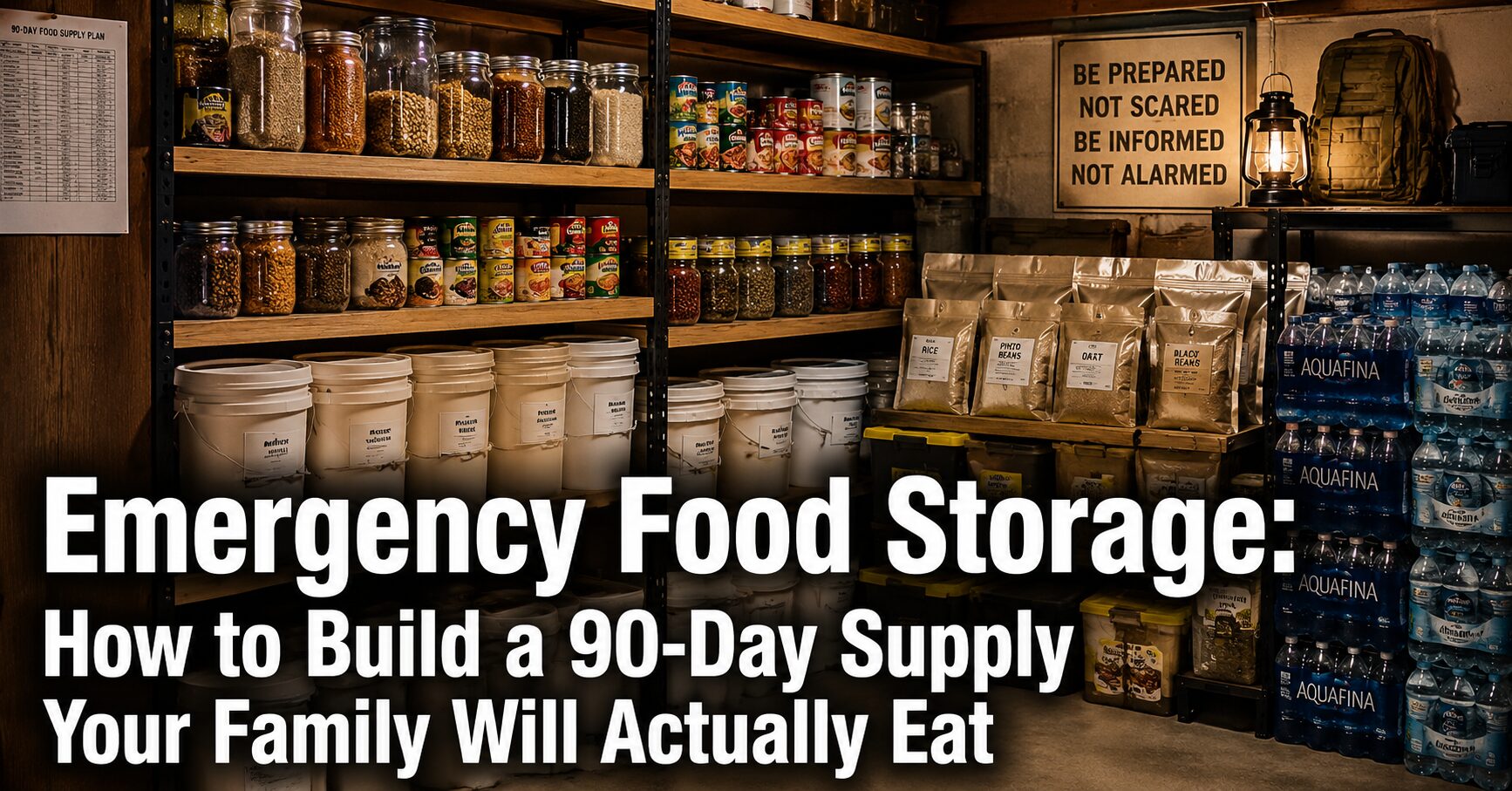
Emergency food storage is where many households fall short in a time of crisis. Learning this basic skill can make all the difference in the world in times of natural disaster and calamity.
Most emergency food guides tell you to stockpile rice and canned beans and call it a day. That advice is not wrong — but it misses the point entirely. A 90-day food supply that your family refuses to eat is not a food supply. It is an expensive pile of anxiety in your pantry. The goal is to have the right food, stored correctly, in quantities that actually match how your household eats.
If you have been following James C. Tanner‘s America at a Crossroads trilogy — particularly While America Burns — you already understand why food security is one of the seven primary domains of household resilience. The just-in-time grocery supply chain is one of the most significant structural vulnerabilities American households face. A 90-day food reserve is not paranoia. It is intelligent risk management. And as Tanner’s broader practical family guide for the decade ahead makes clear, the window for building that reserve is open now in ways it may not be later.
Start With What Your Family Already Eats
The single biggest mistake people make when building an emergency food supply is buying unfamiliar foods in bulk. Begin by looking at what your household actually consumes in a normal week, then build outward from there. Write down your family’s ten most-eaten meals and identify which can be made from shelf-stable ingredients. Those meals become the foundation of your emergency rotation. Pasta with canned tomatoes, rice and beans, oatmeal, peanut butter on crackers — foods your family will actually eat under stress are infinitely more valuable than a pouch of freeze-dried lasagna gathering dust on a shelf.
Emergency Food Storage: The Core Categories of a 90-Day Supply
A well-rounded emergency food supply covers five categories. Pantry staples form the caloric backbone — white rice, rolled oats, dry pasta, flour, sugar, and cooking oil. High-protein foods prevent nutritional gaps — canned tuna, salmon, chicken, beans, lentils, and peanut butter. Shelf-stable fruits and vegetables round out nutrition — canned tomatoes, corn, green beans, and dried fruit. Long-life additions like honey and salt serve double duty as food and preservation tools. And comfort foods matter more than most guides admit — chocolate, granola bars, nuts, and trail mix address the psychological dimension of stress and provide quick energy when it matters most.
Emergency Food Storage: How Much Do You Actually Need?
Plan for approximately 2,000 calories per adult per day and 1,500 per child per day, multiplied by 90 days. For a family of four, that sounds alarming until you realize that 25 pounds of white rice contains roughly 40,000 calories and costs less than $20. Water follows the one-gallon-per-person-per-day rule for drinking, cooking, and basic sanitation — supplemented by a quality gravity filter and purification tablets, which extend your effective supply far beyond physical storage alone.
Storage Conditions That Determine Shelf Life
The three enemies of long-term food storage are heat, moisture, and light. Store food in a cool, dry, dark environment between 4°C and 24°C (40°F to 75°F). Avoid attics, garages, and areas near exterior walls. For dry goods, food-grade Mylar bags with oxygen absorbers inside sealed buckets extend shelf life from 2-5 years to 20-30 years — oxygen is the primary driver of degradation, and removing it dramatically extends viability. Canned goods should be rotated regularly and consumed within 2-3 years for optimal quality.
Emergency Food Storage: The Rotation System That Prevents Waste
A 90-day supply that sits untouched for five years is not food storage — it is a future disposal project. The most effective emergency pantries operate on a first in, first out system: new items go to the back, oldest items are consumed first. This eliminates waste, keeps your supply fresh, and ensures your family is already familiar with the foods in your reserve when they need to rely on them.
The structural analysis in The Collapse Indicators — Book #2 in the America at a Crossroads series — documents why supply chain fragility is one of the most certain consequences of America’s current fiscal trajectory. And as The Rise and Fall of America establishes from the historical record, the households that navigate structural transitions most successfully are those that built their resilience before the disruption arrived. Start with one week. Build to one month. Then build to 90 days. The window is open. Use it.
Frequently Asked Questions
What are the best foods for emergency storage?
The most effective emergency food supplies combine pantry staples, high-protein options, and comfort foods. Pantry staples — white rice, rolled oats, dry pasta — form the caloric foundation. High-protein foods including canned tuna, salmon, chicken, beans, and peanut butter prevent nutritional gaps. Shelf-stable meals like freeze-dried pouches and MREs provide variety and convenience. Long-life additions like honey and salt serve both culinary and preservation purposes. And comfort foods — granola bars, nuts, trail mix, dried fruit, chocolate, and hard candy — address the psychological dimension of stress that extended disruption produces.
How long does emergency food last?
Shelf life varies significantly by food type and storage conditions. Commercially canned goods last 1-5 years and are best rotated within 2-3 years for optimal quality. Dry goods like white rice and beans, when properly sealed in Mylar bags with oxygen absorbers, last 20-30 years. Freeze-dried meals from quality manufacturers carry shelf lives of 25-30 years under proper storage conditions. The key variables are temperature consistency, moisture control, oxygen exposure, and light — controlling all four dramatically extends the usable life of any stored food.
What are the storage requirements for emergency food?
Effective food storage requires a cool, dry, and dark environment with temperatures consistently between 4°C and 24°C (40°F to 75°F). Avoid attics, garages, and concrete floors — heat and moisture degrade quality and accelerate can corrosion. Transfer dry goods like sugar, flour, and dried fruits into airtight, pest-proof containers or food-grade buckets with sealed lids. Oxygen absorbers inside Mylar bags extend dry good shelf life from years to decades. Consistency of temperature matters as much as the temperature itself — fluctuating environments cause more damage than a stable cool-warm environment.
How much food and water does a family actually need for 90 days?
Plan for approximately 2,000 calories per adult per day and 1,500 per child per day. For water, the standard recommendation is one gallon per person per day covering drinking, cooking, and basic sanitation. A family of four would need approximately 360 gallons of water for 90 days — which is why stored water is supplemented with gravity filtration and purification tablets rather than replaced by physical storage alone. Many households find it practical to build their food reserve gradually — starting with a two-week supply from regular grocery shopping and expanding from there rather than attempting to build a full 90-day supply in a single purchasing effort.
How do I keep food safe during a power outage?
Keep refrigerator and freezer doors closed as much as possible. An unopened refrigerator maintains safe temperatures for approximately 4 hours after power loss. A half-full freezer maintains safe temperatures for about 24 hours; a full freezer for approximately 48 hours. Consume perishable refrigerator and freezer contents before opening your long-term non-perishable storage — your shelf-stable reserves are designed for extended disruptions, not short-term outages. A refrigerator thermometer lets you monitor internal temperature without opening the door; food stored above 4°C (40°F) for more than two hours should be treated as potentially unsafe.
This article was written by James C. Tanner, author of the America at a Crossroads trilogy, published by Calico GOLD Publishing. The trilogy — The Rise and Fall of America, The Collapse Indicators, and While America Burns — takes readers from historical diagnosis to present-day crisis to a personal action plan, providing the analytical foundation and practical guidance that any household serious about navigating the decade ahead needs.
1 thought on “Emergency Food Storage: How to Build a 90-Day Supply Your Family Will Actually Eat”
Comments are closed.