
The Superdebtor Status: The End of American Fiscal Hegemony
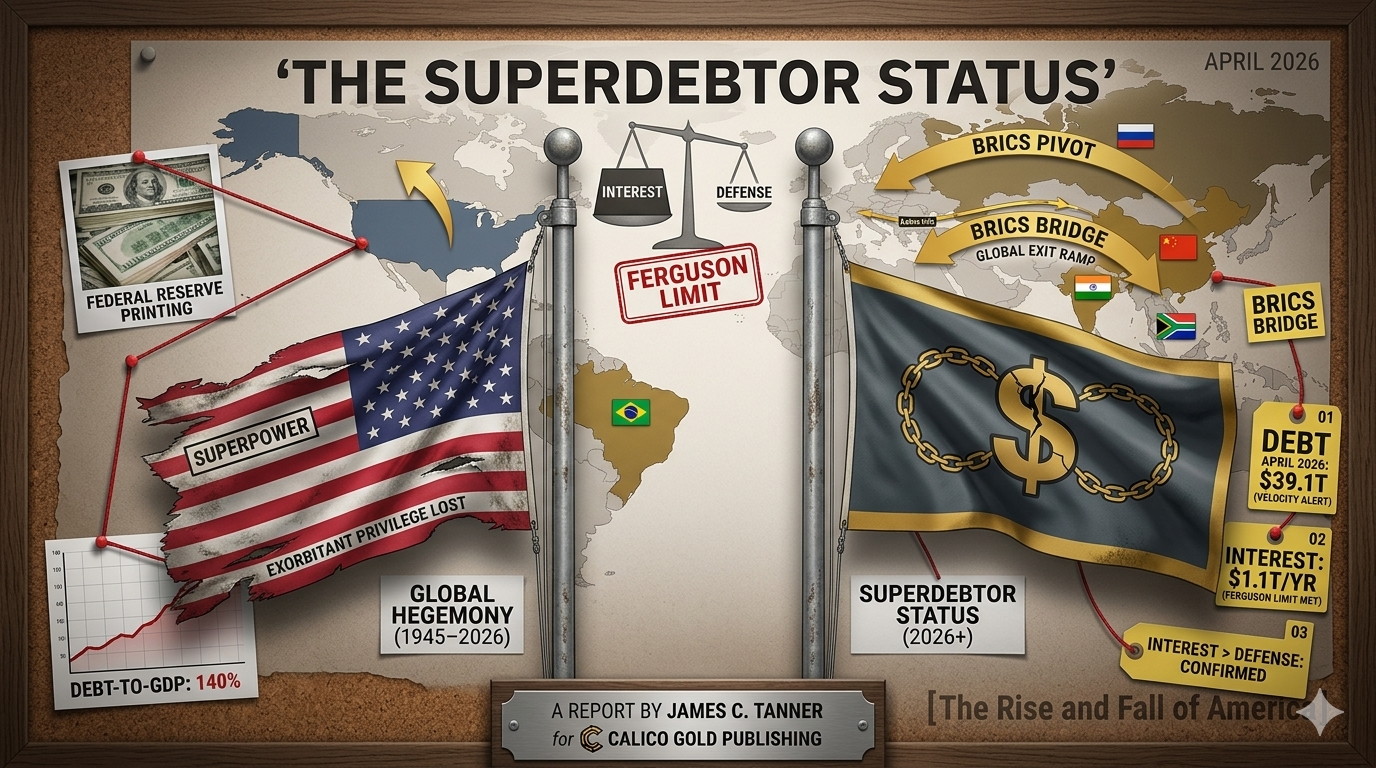
The forensic audit of April 2026 confirms a terminal transition: The United States has officially traded its “Superpower” title for “Superdebtor Status.” This isn’t just an accounting adjustment; it is a fundamental shift in global power dynamics. With a national debt now breaching $39.1 trillion and growing at a velocity of $8.03 billion per day, the U.S. government is no longer defined by its military reach or economic output, but by its unpayable liabilities. As I detail in The Rise and Fall of America, achieving “Superdebtor Status” means the nation’s primary economic activity is now servicing its past, not investing in its future.

“The Rise and Fall of America –
History’s Warning: America in the Crosshairs of Collapse”
Get Your Copy Now — Download Immediately
The paperback edition is available through Amazon, Barnes & Noble, Google Play Books, Apple Books, and wherever books are sold.
The Ferguson Limit: Interest vs. Defense
The clinical definition of “Superdebtor Status” is found in the “Ferguson Limit.” This is the precise moment a state spends more on interest payments than on its own defense. In fiscal year 2026, the U.S. interest expense hit $1.1 trillion, officially eclipsing the entire Department of Defense budget. This inversion is the ultimate forensic indicator. A nation cannot maintain global power when the cost of its previous consumption suffocates its ability to project current strength.
The Loss of Exorbitant Privilege
For decades, the U.S. maintained its deficit spending through “Exorbitant Privilege”—the global requirement for dollars. “Superdebtor Status” ends this. As the US National Debt Graph turned exponential, global trust eroded. This is the catalyst for The BRICS Pivot, as foreign nations realize that a Superdebtor cannot guarantee the long-term value of its currency. This loss of demand is the primary reason why the American Debt-to-GDP ratio matters; the privilege of exporting inflation is gone.
“The Rise and Fall of America –
History’s Warning: America in the Crosshairs of Collapse”
Get Your Copy Now — Download Immediately
The paperback edition is available through Amazon, Barnes & Noble, Google Play Books, Apple Books, and wherever books are sold.
Monetizing the Decay
The final stage of “Superdebtor Status” is debt monetization. When neither domestic taxes nor foreign buyers can fund the state, the central bank must print the difference. This “hidden tax” devalues every dollar in circulation. As we track Is the United States in Decline?, the diagnosis is confirmed not by pessimism, but by the math of the US National Debt Clock. The empire is out of cash.
“The Rise and Fall of America –
History’s Warning: America in the Crosshairs of Collapse”
Get Your Copy Now — Download Immediately
The paperback edition is available through Amazon, Barnes & Noble, Google Play Books, Apple Books, and wherever books are sold.
Frequently Asked Questions
- How can the US maintain superpower status with so much debt? Forensically, it cannot. The transition to “Superdebtor Status” is a terminal diagnosis. While military force remains, the economic foundation that funds it is hollowed out. A nation spending $1.1 trillion on interest cannot simultaneously fund necessary defense, infrastructure, and innovation. The “Superpower” label is now a legacy title, masking an insolvent reality.
- Who does the United States owe all this money to? The $39.1 trillion is split between the “Public” (80%) and “Intragovernmental” accounts (20%). Public holders include the Federal Reserve (the largest single holder), domestic investors, and foreign nations like Japan and the UK. A major concern in 2026 is that BRICS nations are aggressively dumping their U.S. debt, forcing the Fed to “monetize” the difference.
- Is it true that most of the debt is owned by Americans? Yes, if you include the Federal Reserve, which holds over $5 trillion. Domestic holders—pension funds, banks, and individuals—alongside the Fed, own roughly two-thirds of the debt. While this means the interest is paid to Americans, it also means the inevitable rest or “Shatter Event” will directly liquidate the retirement savings and banking capital of the American citizenry.
- What happens to the economy if the debt reaches $60 trillion? Based on the current trajectory, $60 trillion would be reached by 2030. Long before that, the “Ferguson Limit” becomes irreversible. At that level, interest payments consume nearly 50% of all tax revenue, forcing essential services to shut down. The U.S. would face triple-digit interest rates, systemic bank failures, and a currency devaluation that would make the $39.1 trillion crisis look stable.
- What is the risk of the US defaulting on its debt? The forensic risk in 2026 is no longer “low”; it is “elevated.” While the government can always print dollars to avoid a nominal default, a technical default (a delayed interest payment) is a real risk. A nominal default occurs when the printed money devalues the currency so rapidly that the dollar fails as a store of value—the ultimate currency collapse.
- Is the debt too big compared to our GDP? Yes, it is forensically unsustainable. With the debt at $39.1 trillion and GDP estimated at $28 trillion, the ratio is roughly 140%. Historical data confirms that developed economies entering the 130%+ debt-to-GDP zone experience permanent low growth, hyper-devaluation, and are mathematically in the “Event Horizon” of a sovereign debt crisis or reset.
- Why do other countries keep buying US debt? Fewer countries are buying. Demand from traditional buyers (like China) is in terminal decline. Traditional partners keep buying U.S. debt primarily because the dollar remains the least-bad option among G7 currencies, and their own banking systems are inextricably linked to U.S. liquidity. This forced buying is now being challenged by the BRICS alternative system.
- Does the national debt directly affect the average American? Yes, it is the primary driver of the cost-of-living crisis. To manage $39.1 trillion in debt, the government must effectively “inflate” it away. This hidden tax erodes the purchasing power of your wages and savings. Higher interest rates required to manage the debt also make home and car ownership permanently unaffordable for the middle class.
- What happens if the debt becomes unsustainable? You are witnessing it in April 2026. The debt is already unsustainable. It manifests as systemic inflation, geopolitical retreat, the rise of alternative trade blocs like BRICS, and the erosion of domestic trust in institutions. The final “snap” is a currency reset, where old dollar liabilities are effectively cancelled or devalued against new assets like gold or digital currencies.
- Why doesn’t the government just stop spending money? Forensically, it can’t. The government is caught in an “Interest Trap.” Because the debt is so large, stopping all spending except interest and mandatory programs (Social Security, Medicare) still results in a $1+ trillion annual deficit due to the surging interest on previous debt. The state is no longer in control; the math of “Superdebtor Status” is in control.
About the Author: James C. Tanner is a special investigator and the owner of Calico GOLD Publishing. To prepare for the “Snap” of the Superdebtor Status, read The Rise and Fall of America — History’s Warning: America in the Crosshairs of Collapse.