
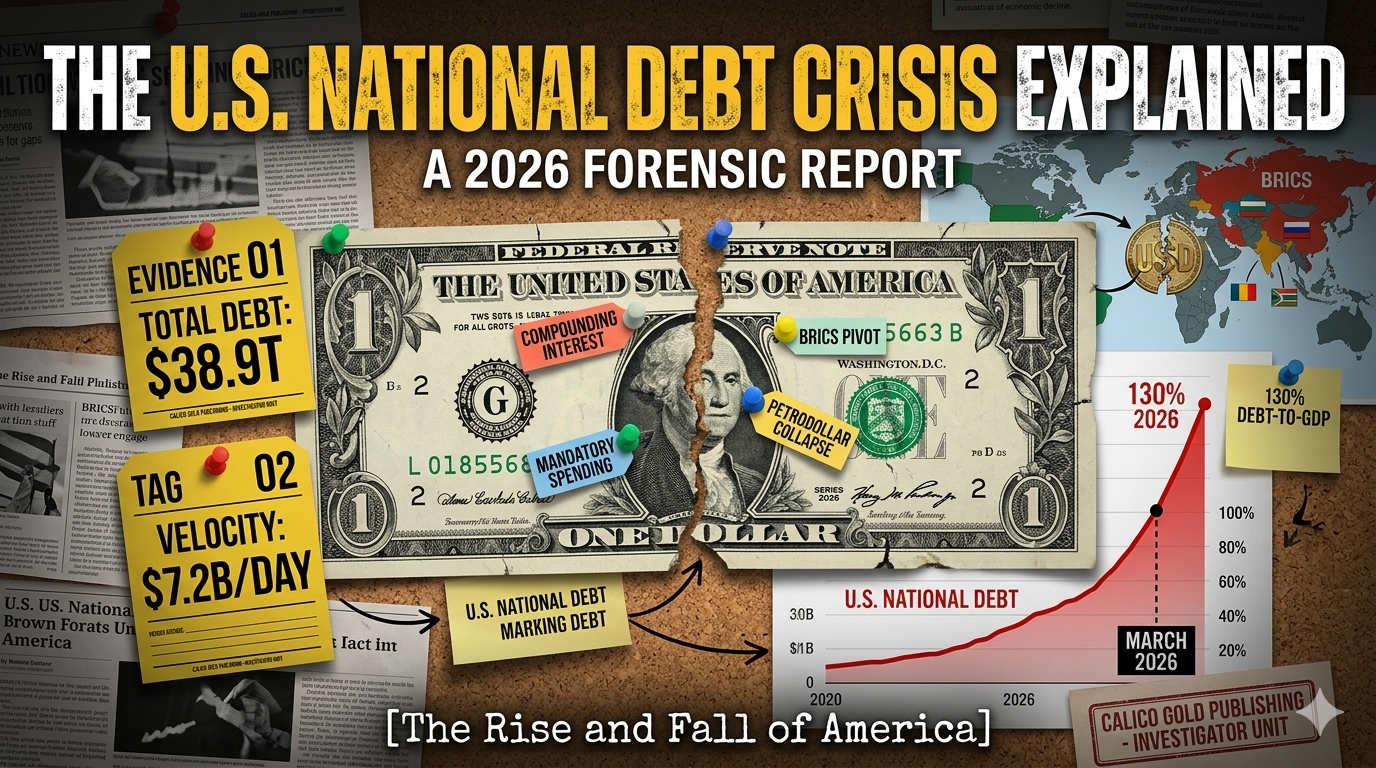
The U.S. national debt crisis explained in simple terms is a story of velocity outrunning reality. As of mid-March 2026, the gross national debt has surged past $38.88 trillion. While the number itself is difficult to visualize, the forensic reality is found in the speed of the burn. We are currently borrowing $7.23 billion every single day—roughly $301 million every hour—to sustain a federal budget that has become entirely decoupled from tax revenue. To have the U.S. national debt crisis explained properly, one must look at the “Triple-Threat” of compounding interest, imperial overstretch, and the loss of global dollar demand.
The Rise and Fall of America — History’s Warning: America in the Crosshairs of Collapse
Get Your Copy Now — Download Immediately
The paperback edition is available through Amazon, Barnes & Noble, Google Play Books, Apple Books, and wherever books are sold.
The Interest Trap: The U.S. National Debt Crisis Explained through Math
The most critical component of the U.S. national debt crisis explained is the “Interest Trap.” For decades, low interest rates allowed Washington to carry massive debt with minimal pain. That era ended in 2025. Today, net interest outlays are on track to exceed $1.1 trillion annually. This is a historic “Shatter Event.” We have reached the point where the interest on our past debt costs more than our entire national defense budget. This is the “Ferguson Limit,” and as I detail in The Rise and Fall of America, no empire has ever crossed this threshold and remained a superpower.
Why the U.S. National Debt Crisis Explained via Spending is a Myth
When people ask for the U.S. national debt crisis explained, they often focus on “discretionary” spending. However, the forensic truth is found in mandatory obligations. The “Big Three”—Social Security, Medicare, and Interest—now consume the vast majority of all federal tax revenue. By the time we pay for the promises of the past and the interest on our previous mistakes, there is virtually nothing left for the present. In March 2026, the federal deficit is projected to hit $1.85 trillion. This “black hole” is being filled by issuing new debt at higher rates, creating a self-reinforcing loop that devalues the currency in your pocket.
The Rise and Fall of America — History’s Warning: America in the Crosshairs of Collapse
Get Your Copy Now — Download Immediately
The paperback edition is available through Amazon, Barnes & Noble, Google Play Books, Apple Books, and wherever books are sold.
Geopolitics and the U.S. National Debt Crisis Explained
A “Superdebtor” cannot project power the same way a “Superpower” can. As the world watches the U.S. national debt crisis explained by the sheer weight of the numbers, our adversaries are acting. The rise of BRICS and the movement toward “de-dollarization” are direct responses to American insolvency. When a nation’s debt reaches 130% of its GDP, it loses its “Exorbitant Privilege.” The world begins to look for a more stable store of value, and the “Petrodollar” system—which has subsidized American life for 50 years—begins to fracture.
The Final Verdict on the U.S. National Debt Crisis Explained
Ultimately, having the U.S. national debt crisis explained requires an investigator’s eye, not a politician’s spin. We are witnessing the mathematical endgame of a century-long experiment in fiat expansion. Understanding this crisis is the first step toward surviving the “Great Reset” that history suggests is inevitable. For a deeper dive into these forensic findings, refer to the evidence compiled in The Rise and Fall of America.
About the Author: James C. Tanner is a special investigator into economic history and the owner of Calico GOLD Publishing. He is the author of The Rise and Fall of America, the definitive forensic report on the 2026 debt crisis.
The Rise and Fall of America — History’s Warning: America in the Crosshairs of Collapse
Get Your Copy Now — Download Immediately
The paperback edition is available through Amazon, Barnes & Noble, Google Play Books, Apple Books, and wherever books are sold.
2 thoughts on “The U.S. National Debt Crisis Explained: A Forensic Analysis”
Comments are closed.