
The American Debt-to-GDP Ratio and Why It Matters: The Mathematical Event Horizon
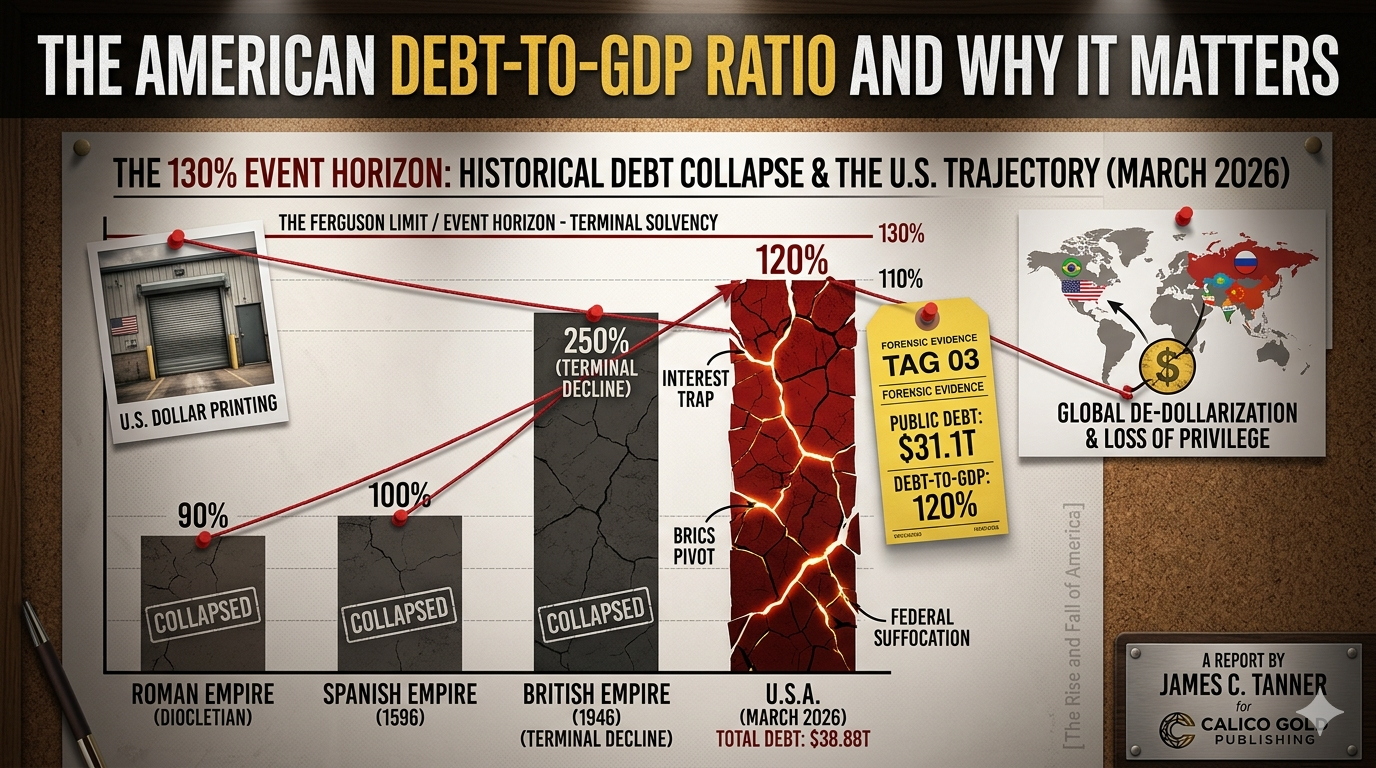
In the world of forensic economics, numbers rarely lie, but they often scream. As of March 2026, the data screaming the loudest is the relationship between what the United States produces and what it owes. Understanding the American Debt-to-GDP ratio and why it matters is no longer a luxury for academics; it is a survival requirement for every citizen. With the national debt now exceeding $38.88 trillion, we have reached a stage where the debt is growing faster than the economy itself. This divergence isn’t just a fiscal hurdle—it is a “Shatter Event” in the making.
The Rise and Fall of America — History’s Warning: America in the Crosshairs of Collapse
<
Get Your Copy Now — Download Immediately
The paperback edition is available through Amazon, Barnes & Noble, Google Play Books, Apple Books, and wherever books are sold.
Defining the Scale: Production vs. Liability
To understand the American Debt-to-GDP ratio and why it matters, one must first understand what the ratio represents. It is a nation’s “leverage” score. Gross Domestic Product (GDP) is the total value of all goods and services produced. When the debt exceeds the GDP, it means the nation owes more than it earns in a year. In March 2026, the U.S. public debt-to-GDP ratio has climbed toward 120%, a level historically reserved for nations in the midst of total war or terminal decline.
The 77% Tipping Point
World Bank research has consistently shown that for developed economies, a debt-to-GDP ratio exceeding 77% for prolonged periods results in a significant drag on economic growth. Every percentage point above this threshold shaves off a portion of annual real growth. As we discuss in The Rise and Fall of America, the U.S. has been living well above this “Tipping Point” for years. This is precisely why the American Debt-to-GDP ratio and why it matters is the most critical metric for 2026; we are no longer just slowing down—we are actively suffocating the private economy to feed the federal debt machine.
The Rise and Fall of America — History’s Warning: America in the Crosshairs of Collapse
Get Your Copy Now — Download Immediately
The paperback edition is available through Amazon, Barnes & Noble, Google Play Books, Apple Books, and wherever books are sold.
The Interest Trap and the “Shatter Event”
The reason the American Debt-to-GDP ratio and why it matters has become so urgent in 2026 is the “Interest Trap.” When the ratio is low, interest payments are manageable. But at 120%, even a small increase in interest rates causes the cost of servicing that debt to explode. We are currently spending $301 million per hour on interest alone. This creates a “Snowball Effect” where we must borrow more money just to pay the interest on the money we already borrowed. This is the definition of a debt spiral, and it is the core reason why the American Debt-to-GDP ratio and why it matters to your personal savings and the value of the dollar.
Geopolitical Consequences: The Loss of the Exit Ramp
Historically, when a superpower’s debt-to-GDP ratio crossed the 100% threshold, it began to lose its global influence. We see this today with the BRICS nations actively seeking an exit from the dollar-denominated system. They recognize that a nation with a 120% ratio is a credit risk. This loss of demand for U.S. Treasuries is the final stage of the crisis. Understanding the American Debt-to-GDP ratio and why it matters helps us see that the “Exorbitant Privilege” of the dollar is not a permanent law of nature—it is a trust-based system that is currently being liquidated.
The Rise and Fall of America — History’s Warning: America in the Crosshairs of Collapse
Get Your Copy Now — Download Immediately
The paperback edition is available through Amazon, Barnes & Noble, Google Play Books, Apple Books, and wherever books are sold.
Frequently Asked Questions
1. Debt to GDP Ratio By Country? As of March 2026, Japan remains the global leader with a ratio exceeding 230%, while Italy sits at 135%. The U.S. has rapidly climbed to 120%, placing it among the most indebted nations in history. Conversely, countries like Germany (63%) and Russia (20%) maintain significantly lower leverage, providing them more fiscal “shielding” during global resets.
2. What Is The Ideal Debt to GDP ratio? Economists generally consider an “ideal” or sustainable ratio for a healthy, growing economy to be below 60%. This level allows a government to respond to emergencies without risking insolvency. Staying below this threshold ensures that productive capital stays in the private sector rather than being diverted to pay for government interest costs and past federal spending.
3. Debt to GDP Ratio Should Be High or Low? A debt-to-GDP ratio should always be as low as possible. A low ratio indicates a nation can easily pay back its debts without debasing its currency. A high ratio, like the one we see in 2026, indicates that a nation is over-leveraged, leading to higher taxes, lower economic growth, and an increased risk of a sovereign debt crisis.
4. Why Is Debt to GDP Ratio Important? The ratio is important because it measures a country’s ability to pay back its debt. It acts as a “credit score” for the nation. If the ratio gets too high, investors lose confidence, interest rates rise, and the government may be forced to print money to cover costs, leading to the hyperinflationary “Shatter Events” described in history.
5. What is the Public Debt to GDP Ratio Meaning? The public debt-to-GDP ratio meaning refers specifically to the debt held by the public (investors, foreign governments) as a percentage of the total economy. It excludes “intragovernmental” IOUs. In 2026, the public ratio hit 101%, a historic psychological and economic barrier that signals the U.S. government is now a net-debtor to the global market.
About the Author: James C. Tanner is a special investigator into economic cycles and the owner of Calico GOLD Publishing. For a deeper forensic look at how these ratios signal the end of the American Century, read The Rise and Fall of America.