
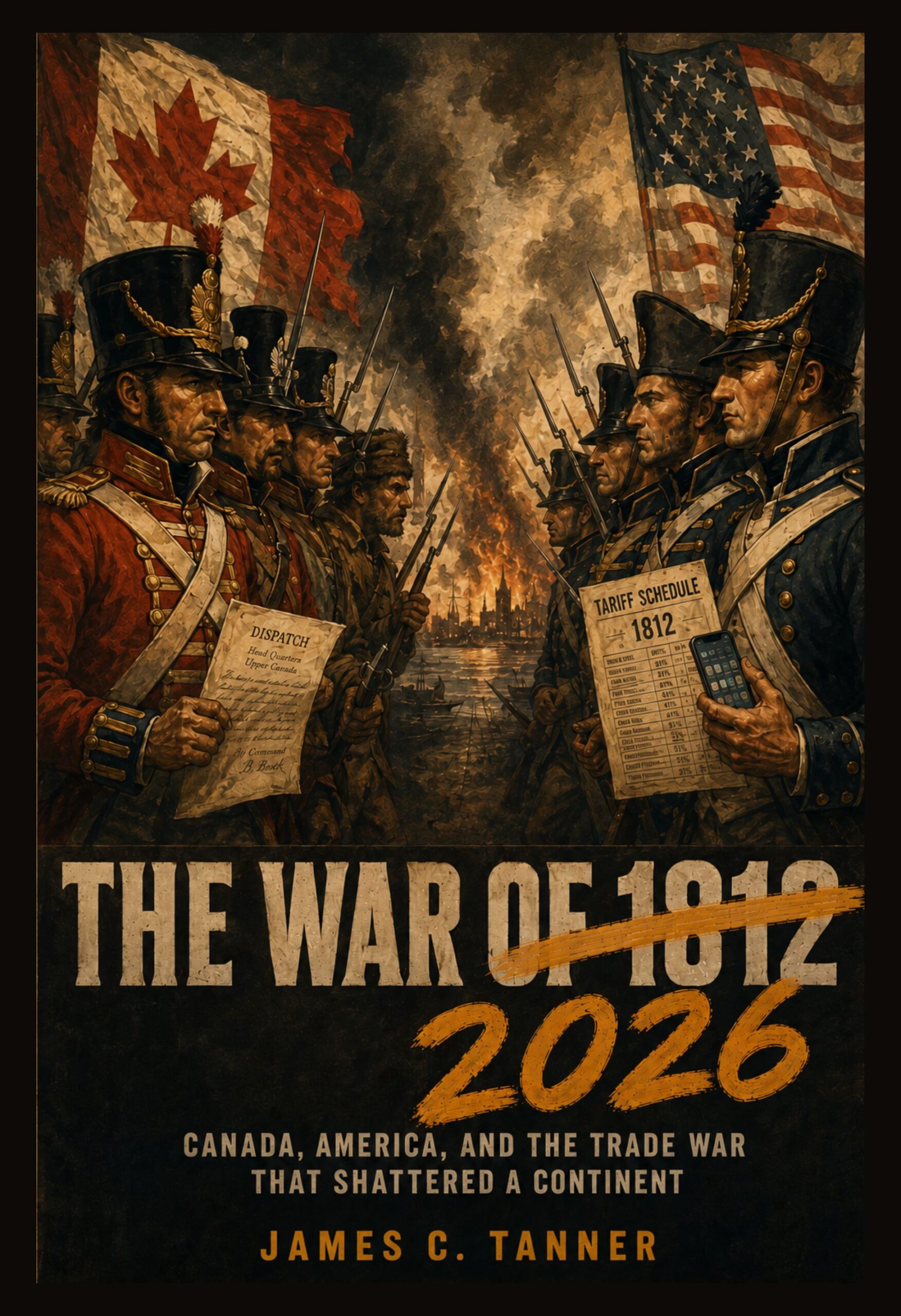
The War of 2026: Canada, America, and the Trade War That Shattered a Continent
$9.99
The War of 2026 documents the trade war between Canada and the United States — what happened, why it was predictable, and what it will cost the continent. Told without political bias. Every claim is sourced.
Buy the ebook today for $9.99 and receive an ebook copy of The Rise and Fall of America as a free bonus — both ebooks delivered instantly as downloads. $9.99 for the two ebooks… only available here.
If you want the paperback, get it on Amazon.
Description
The War of 2026 is the definitive account of the trade war between Canada and the United States that began in August 2026.
The Ghosts from the War of 1812 have returned to haunt us.
On the morning of August 22, 2026, Canada’s Prime Minister walked to a wall of cameras on Parliament Hill.
A reporter asked why it looked like Canada was going to war.
His answer was ten words long.
“You’re at war when you get attacked. We got attacked.”
That sentence changed everything.
The War of 2026 Paperback Version
Now Available on Amazon
The War of 2026 FREE BONUS From This Site Only
When you purchase the ebook copy of “The War of 2026”
you will automatically receive a free ebook copy of our highly acclaimed book,
“The Rise and Fall of America”.
Three days of trade talks in Washington had just collapsed. Within hours, American tariffs of 50 percent hit Canadian cement, building materials, liquor, and hockey equipment — roughly $20 billion U.S. in goods. By Saturday morning, Canada had matched them dollar for dollar, targeting American steel, dairy, appliances, agricultural equipment, and electronics.
Two neighbors — the closest trading partners on earth — were now taxing their own citizens for the privilege of punishing each other.
It happened before. Almost word for word.
The War of 1812 did not begin with soldiers. It began with a trade policy — one so badly designed that it devastated the country that wrote it far more than the country it was aimed at. American exports collapsed 87 percent in twelve months. New England was gutted. Ships sat idle. Merchant houses that had operated for generations went bankrupt in a single season.
Britain adjusted and moved on. America bled.
Two centuries later, the same assumptions are being made by the same kind of people — and the same kind of damage is already arriving, quietly, as invoices 30 percent higher than last quarter, hiring freezes, contractor bids that no longer win.
This book documents what is happening, why it was predictable, what it will cost, and what the continent looks like when it’s over.
What makes 2026 more dangerous than 1812?
This time, the two economies are not just trading with each other. They are built into each other. Components cross the border repeatedly before a finished product exists. A tariff does not touch such a product once — it touches it at every crossing, and the cost compounds.
This time, Canada has alternatives. A growing majority of Canadians now view China as a more reliable partner than the United States. The European Union has begun fast-tracking a trade framework Canada once put on hold. The pivot is already underway.
This time, allies are watching. Much of the Free World is now describing the United States as a North American version of Russia — a large country that uses economic size as a weapon against smaller neighbors. That perception does not reverse easily, and it does not stay contained to Canada.
This time, the American political identity of the sitting president has been woven into the tariff strategy itself — meaning the off-ramp requires someone to lose face, and neither side has shown the willingness to go first.
THE WAR OF 2026 is not a political book. It takes no side. It follows the facts, sources every claim, and states conflicts in the data rather than resolving them in favor of a preferred number.
It is, however, a book with an argument: that what is happening between Canada and the United States is not a negotiation that went sideways. It is a pattern — documented, repeatable, and already underway — in which economic coercion builds momentum that outruns the facts, and by the time anyone checks whether the original grievance still exists, the answer no longer matters.
The War of 1812 ended without resolving the grievances that caused it. Those grievances waited two centuries.
They came back.
James C. Tanner is the author of more than 70 published titles, including The Great North American Divorce — Canada vs The USA, in which the twelve lessons North America failed to learn from the War of 1812 were first published. He was right about all twelve. This book is what happened next.
Related products
-
The Rise and Fall of America — History’s Warning: America in the Crosshairs of Collapse
$6.99 Add to cart -
While America Burns: How to Protect Your Family, Preserve Your Wealth, and Position for the Rebuilding of America
$6.99 Add to cart -

Why MOMMY and DADDY Don’t Love Each Other Anymore
$6.99 Add to cart -

The Hidden Cost of ALWAYS Being The Strong One
$4.99 Add to cart